
Basic and Individual
A two-parter this week, but all about essential skills.

I went to my running club this week. We were doing a session called “Up & Overs”, where you sprint up a hill, keep the pace on a downhill and recover on a flat road, all in a neat local triangle. I obviously went out way too fast up the first hill, seeing how long I could hang on to the front boys, trying to keep another lad from overtaking me for as long as possible. The next four reps were diminishing returns, but it was all quite fun, really.
Afterwards, talking with the man who’d overtaken me, we revealed that while I always go off too fast, it takes him a while to warm into it. He is faster than me in general, but I like the idea of training with him again. I tried to keep him the same distance from me throughout the rest of the session, the red light from his head torch blinking in the distance, but he stretched ahead ever so slightly on every rep. Solid.
I was in no man’s land. Apart from his light, I was completely on my own for every rep around the triangle. I had to laugh - I’d come to club to run with others, and ended up on my own. I either had to get faster or slow down. But the ghosts of others were keeping me pushing so that I wasn’t overtaken, keeping me pushing so as not to fall behind. This is the sort of race-day mentality that I love, and reflecting afterwards, I wondered if there’s a psychological element to these sessions that’s beneficial for those scenarios. If I can practice being really comfortable in that situation, I will remove any novel stress and be able to react with a clear head. I think it’s helpful to strip ego away in that circumstance and just to play moves according to the cards in your hand.
Otherwise you feel pressured, get distracted and sprain an ankle. Or something.
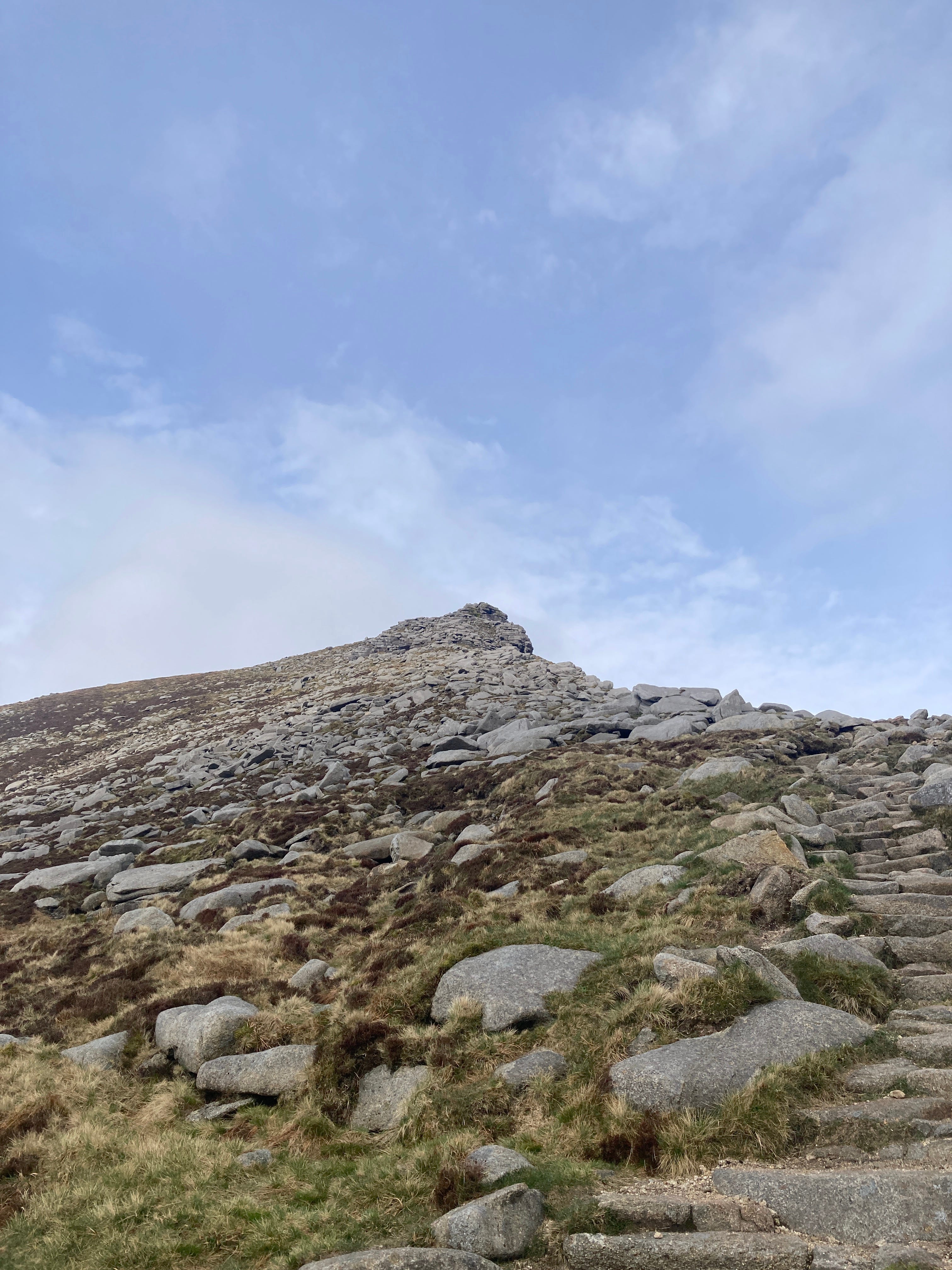
Warning: the following contains running nerd content. It is mainly running nerd content. Like myself chasing the men up the hill, it’s okay to just let it speed away from you.
The GOAT (Greatest of All Time) Kilian Jornet has spoken:
https://mtnath.com/stateoftrail2026/
We crawled to the top of the mountain and sat at his feet to listen. He has written a piece on his blog about the state of trail running - where we are, and where it’s going. It’s quite a long piece, helpfully broken up into categories, but I think worth a read if you’re a superfan of the sport like me.
What caught me most about it was a call to remember simplicity: he acknowledges that trends like lactate monitoring, heat training and breathing sensors will continue to develop and grow more accurate, and we love these shiny new things, they make us believe we have a quick fix to becoming better athletes. But, Jornet says, “…[the] reality is that 99% of our capacity comes from the BASIC and INDIVIDUAL boring and unexciting training. Hope is that we finally give more attention to those: better connections to other humans and nature, better general nutrition, lower stress and more basic training thought towards the individual capacities that every of us has.” You can’t outrun a bad diet, and you can’t lactate monitor your way out of the demands of mountainous terrain.
On that, a section I found particularly interesting was his analysis of the decline of technical races. Nowadays, what we refer to as “technical terrain” in trail running is at most a couple of roots and rocks. That is not technical by the standards of traditional sky races, the likes of which used to be dominated by a handful of true mountaineers. Jornet reflects on the fact that in order for a race to be profitable, it needs to be able to accept more participants. In order to accept more participants, it needs to be safer to account for the breadth of experience and level of skill. As such, the trickier parts of the race get diverted. Imagine if Ultra Trail Snowdonia ran over Crib Goch? Or if more races in the Lake District took in an ascent of Scafell Pike? The insurance would be sky high.
This lean towards safer events is not necessarily a problem, you might think, but it signifies a death of literacy in the mountains. We keep hearing about groups of people who have had to be rescued from the mountains, sometimes carrying tiny dogs, because they are ill-equipped and inexperienced, having a panic attack in joggers and trainers while a couple of kids carve out steps in the snow for them to safely get down. I’m sorry, but that’s so lame. I sympathise, I get it, I do understand, but I think it’s a shame we’re not educated in the ways to approach some of the most beautiful landscapes in our country, and in the world. I deeply want that education and I want it for others. I want us all to be able to properly see, experience, appreciate and therefore care about the future of our natural world.
Jornet finishes this point simply by saying, “But if we don’t want to become a long or high elevation cross country sport in the future, and for a more friendly entry to new participants into the sport, the implementation of a technical grading system will be necessary.” I massively concur. It’s all well and good looking at the distance and elevation of a mountain ultra, but that’s 30% of the story. I think we’d see a much lower DNF rate if participants really knew the technicality of what they were getting into. As the sport continues to grow, as more and more races sell out in days or go through a lottery system, I believe the entry criteria should move to something more similar to the fell running model in the UK. I looked at trying to do a particular fell race this summer but as it stands, I can’t, because I haven’t completed any races of a lower grading. They literally state that a waymarked trail ultra does not qualify you for the race. You have to be able to prove that you can navigate yourself. For example:
“To be eligible to compete in Borrowdale Fell Race, runners must have previous experience of long, arduous fell races and, if they have not previously completed Borrowdale Fell Race, runners must have completed at least two different category A or B long or two different category A medium fell races (race categories as defined by the Fell Runners Association) since 1st January 2023. Entry to Borrowdale Fell Race will be refused to any runner who cannot demonstrate such experience.”
My first thought was that it’s easy if you’ve grown up with it. But why don’t we all grow up with it, to some degree? Socio-economic, opportunity, geography, all of that. But clearly even a basic understanding is missing: a basic, theoretical appreciation of the demands.
I just think the categories of technicality is a really interesting point, and as more elite road runners are moving over to trail, crushing course records with relative ease, I’ve maintained that I want to see how they fair at a race like Hardrock 100. Or indeed, Ultra Trail Snowdonia. Running on hard-packed, polished trails with 2mm lugs is lovely. Skipping over the odd tree route is fun. But it’s not the same sport as those tough, gnarly, mountainous ultras, and at the moment we’re comparing apples to oranges, or eating an orange expecting it to be just like an apple. If we know what we’re getting into, and if we can experience an appropriate level of literacy for the challenge ahead of us, we only stand to get more out of it.
I want it, I want to orienteer, I want to know my way around a foggy fell with a compass and a map. I want to read the weather, I want to have looked at that cloud coming over the fells in the Lake District during the 7 Valleys race in September and known, understood, stayed low, waited it out, got layers on when it was safer and easier to do so. Instead I took a video of it in awe and hiked on. Classic, classy millennial. These are simple skills, forgotten in the fug of super foams and carbon plates and learning whether ice baths are actually detrimental to recovery. What use is any of that when you’ve got hypothermia? (Well actually, would regular ice baths reduce your chances of catching hypothermia? There’s a thought.) I think my time and headspace could be better devoted to continuing to learn the essential, natural, truly life-saving skills of being outdoors and in the wild. The benefits there far exceed those of a shiny new pair of shoes. And yet I believe the right lug depth will save me. Oh, am I doomed?
I also enjoyed the Kilian piece and have been having similar thoughts - such is the power and influence of Kilian!
I did the Snowdon Skyrace a couple of years ago - which does go over Crib Goch (terrifying with cramp!) - and it was the technically toughest thing I've ever done. I knew it would be hard, as the tricky nature of it was well communicated, but the extra-hardness of it still caught me by surprise. With a strict fell-racing grading entry system, I'm not sure my entry would have been accepted.
(For what it's worth, I don't think the ridge of Crib Goch is the hardest thing about it: the slabby bouldering scramble just to get up there spooks me more. It's a good filter: if you can't get up there, you're unlikely to get all the way across it)
Have you come across the Isle of Wight Fell Series, which doubles as the South of England Championships? There's three races - AS, BM, and CL - which just about squeak into being considered fell races, but don't count for much if you want to get into the tougher Northern races. It's still a fun weekend, though.
After watching a film about it, I'm drawn to Trofeo Kima as it looks beautiful, but I know I'm highly unlikely to get the skill and experience to enter unless I move to the mountains. Even though I'm probably never going to run it, I still want proper alpinist races to thrive.
And I wonder if carbon trail shoes would be a thing if not for the dominance of less-technical off-road ultras? Carbon racers might be good for UTMB, but you're not going to enjoy Crib Goch with a 40mm stack height...