Catbells
Hiking up fells in the Lake District, and exploring the connection between a hand and rock

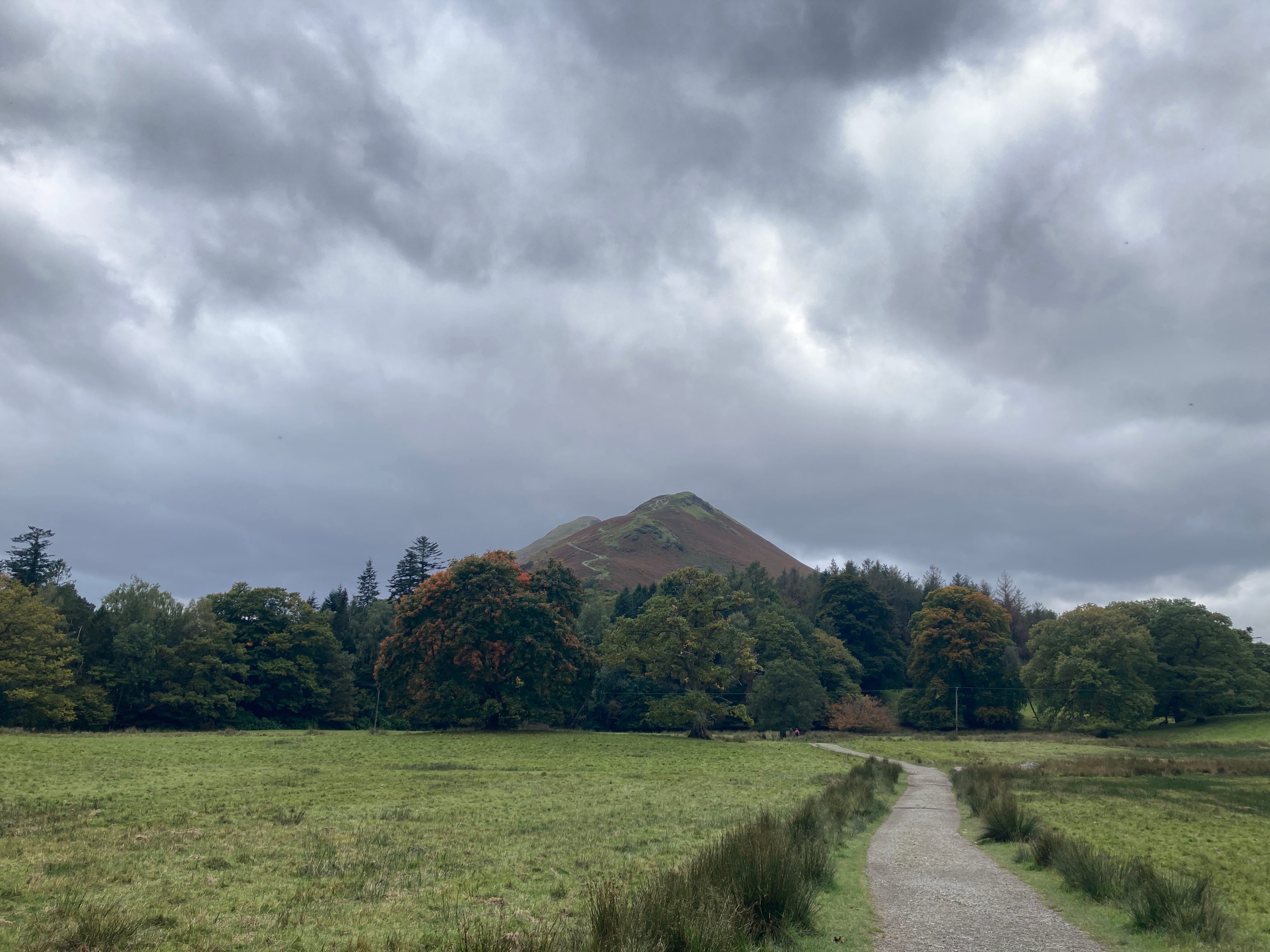
I stand at sea level and scan my eyes to the summit of a mountain and I can’t get the perspective right. Clumps of trees that are gathered around its sides - the forests - could surely be passed through in mere minutes, they look so small, and the ridges on the top are just a series of steps. As for the vast gullies down the middle of a mountain, would I simply run free with my arms wide down one side and scramble back up the other? Even from the summit of a mountain, I believe that walking across the saddle to another summit should be completely straightforward. I could hit all of the peaks in a mountain range in what, an hour? I think this extreme optimism comes from my lack of experience, but also in response to feeling wildly out of my depth.
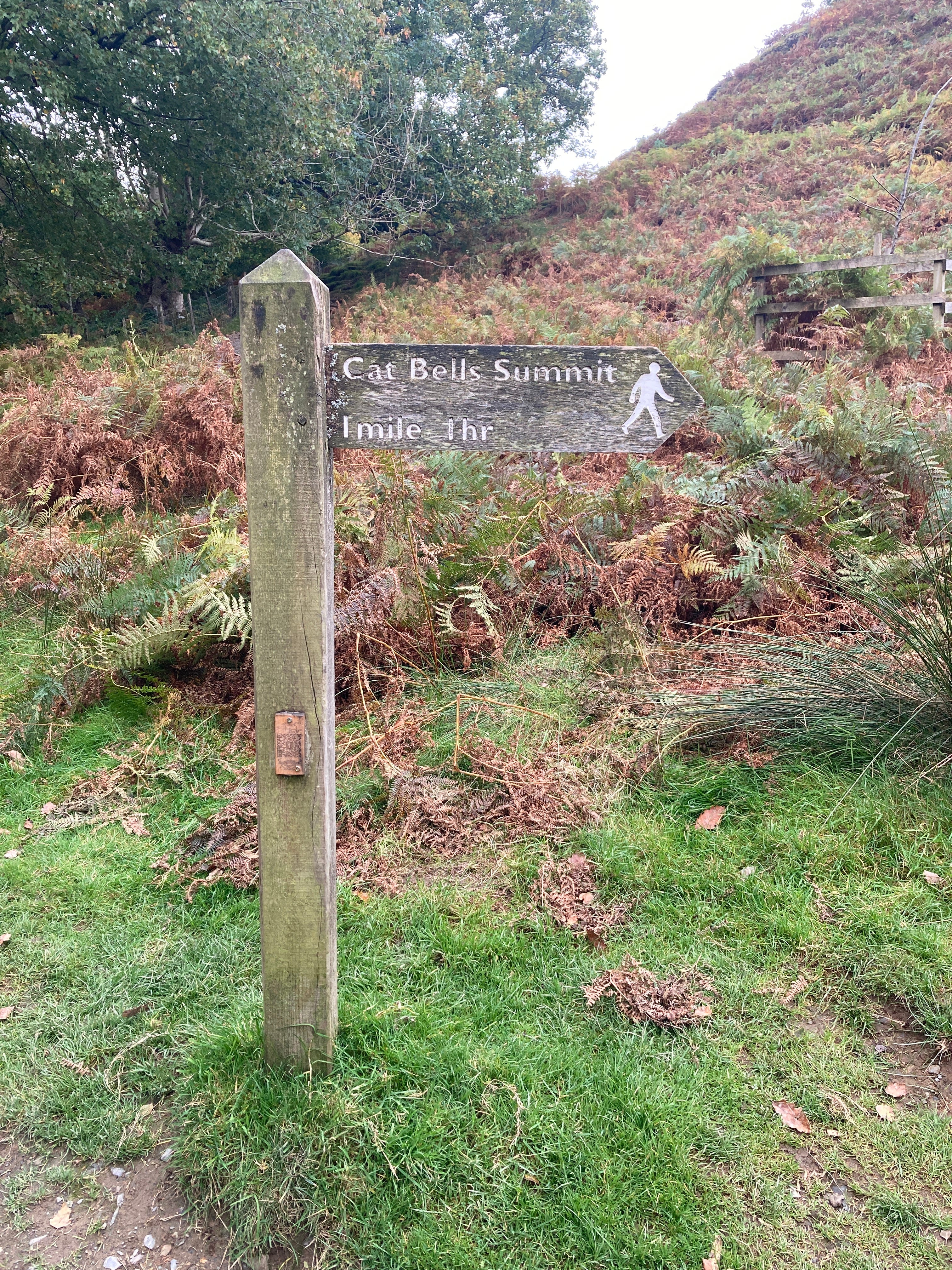
This was how Catbells - a fell in the Lake District - seemed to me as I strolled towards it beside the River Derwent from the town of Keswick. I could see a clear zigzag of path up the fell and it looked like it would take just a few steps in each direction before I’d reach the top. No doubt I’d be back in town before the pub I wanted to visit was even open. I reached the signpost at the bottom of the fell: “Catbells summit, 1 mile, one hour.” One hour? I smiled. Of course, they have to say these things to be inclusive. I’d be back at this sign in no time.
Well, I began the ascent and was immediately too hot, out of breath and needed water. I’d barely climbed an average hill, I’d barely passed the first switchback. Was I immediately at altitude, or something? I just needed to stop and regroup. I had to remind myself that I caught a chill in an ultra three days ago, I was bedridden with an illness a week go, this wasn’t difficult, I was just compromised. Yes, that was it. I took a sip of water and continued the calf tingling ascent along the dusty trail between the gorse bushes, trying to keep my breathing under control. An older man ahead of me was keeping a slower, seemingly meditative pace. His steps were even, unhurried, unfazed by each turn in the switchbacks, nor my passing hello and good morning. The expanding view of Derwentwater hoved into view for him with no rush, no fuss, with gentle presence in each step. I tried to emulate his style and immediately failed, eager as I was to reach the top, fuelled by novelty and adventure.
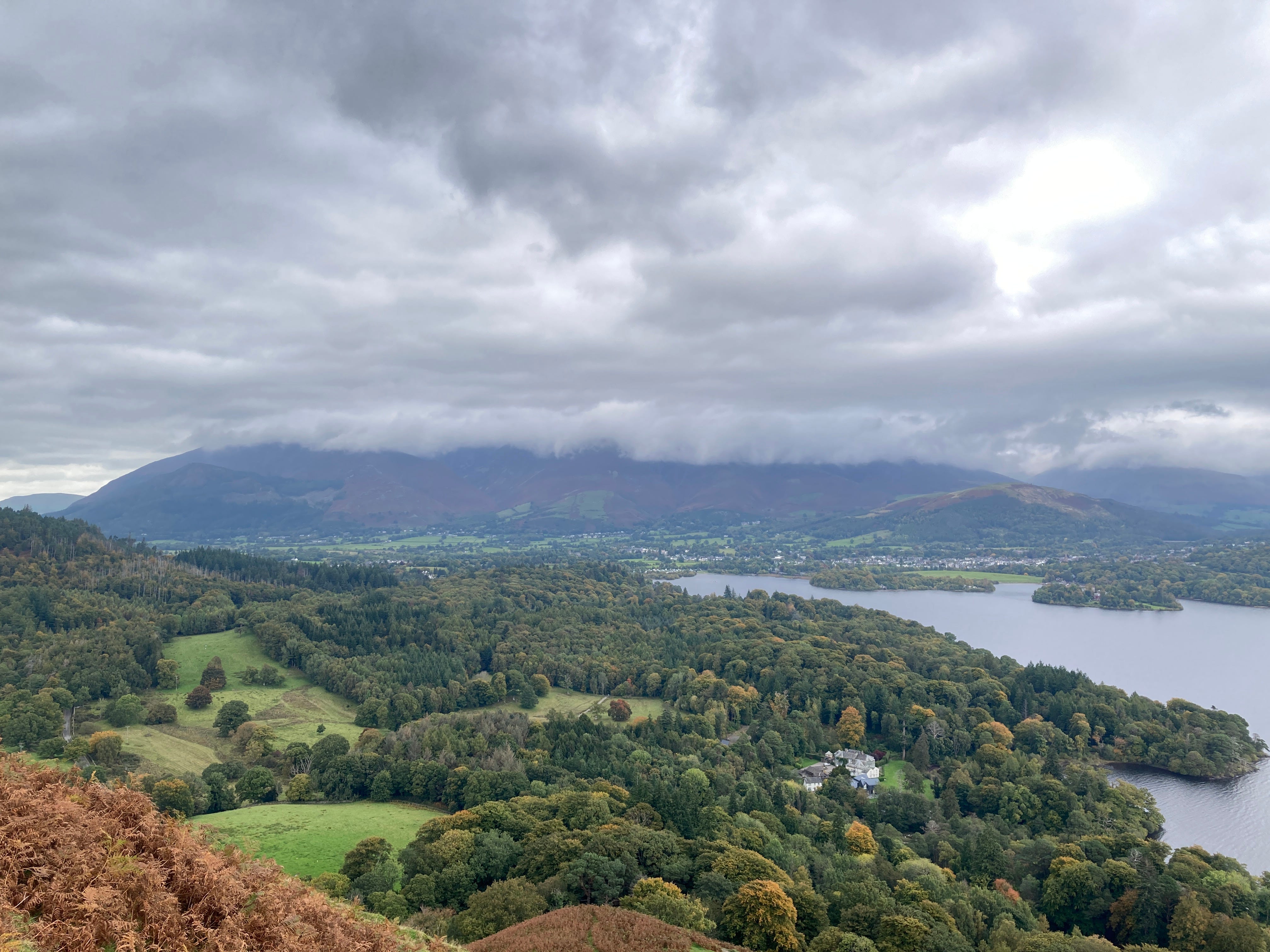
I passed children wailing and screaming, parents wrestling with tiny bags and coats, and wondered if the family would reach the summit at all. I passed two young women discussing the best way down, recalling a similar patch of scree on Skiddaw. The switchbacks had stopped now and it seemed we were into the mountain climb in earnest: the sides of the fell began to drop away more steeply and the view of Keswick at the head of Derwentwater was now clear, I could actually see the distance I had walked so far. A sweet dip of houses and farms appeared to my right, streaked with fluorescent green in the patchy sunlight and completely surrounded by cosy lumps of fells. The mountain range continued ahead of me and I was reaching false summits now; it was only because a man commented to his partner that they must have been descending “for what, 25 minutes?” that I realised I should withhold my anticipation for a while yet.
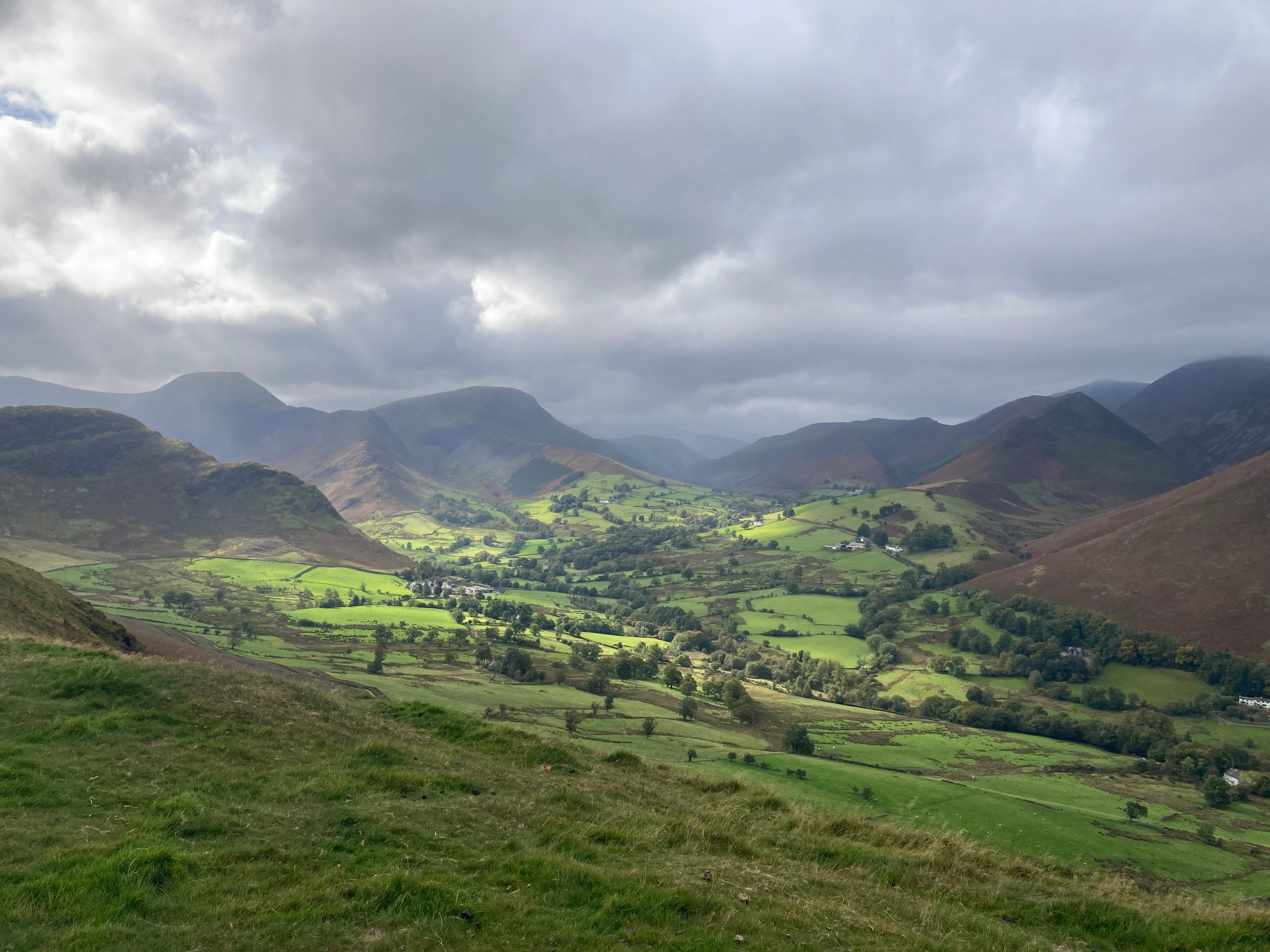
I reached a group, maybe a family, maybe friends, who had paused in conversation in front of a scramble up some boulders. I felt too hot, smelly and self-conscious to sneak through them to the clearest path up, so my eyes scanned the wall of rocks for an alternative route. In landscapes like this, there are not necessarily paths made for humans. Sometimes there is, yes, rocks will be laid to make a clear path or steps to help preserve the verges. But most often there isn’t a designated way up, down or through, there are no cheerful National Trust signposts, the only wrong way is the way that is impossible, or leads elsewhere. There will be an easiest way, there will be a way that is more worn by footprints, the rock might even be smoothed by a quantity of handholds, but ultimately you find your own route. I find that opening up this part my mind is a really nourishing aspect of being in these sorts of landscapes. It leads to great feelings of freedom, peace, well-being and autonomy.
My eyes found a route, like an image appearing in one of those magic-eye puzzles. I got my feet in place and then I had the strangest sensation: when I grasped hold of the rock to scramble up it, there was a rightness to the way it felt in my hands. It was as if the grooves in my fingertips locked into the grooves in the rock, the tips of my fingers bent to the exact curvature of a lip or crack. Each finger and thumb applied a different and appropriate pressure to give me purchase, but also lightness: I could adjust at a moments notice, lifting and shifting to provide a longer arm span, or tightening to hold on while I moved a foot. This locking in, this fractal connection, felt like warmth but without a change in temperature. It felt like the comfort of something soft, without being soft. Indeed, it was harsh, but it didn’t necessarily hurt. It was more like feet in sand. Yes, the way sand feels between toes. Particles seemed to gather around my hands and envelope me in safety, as if I could hang from those holds in the rock alone. I’ve only climbed up boulders like this a handful of times, a couple of those were in the race a few days previously, it didn’t seem like enough experience for it to feel so natural. How could this sensation come so easily for something I’ve never properly done before? Maybe we all feel it?
At the next plateau, I could finally see what I believed was truly the summit - I saw brightly coloured jackets making their way up the next ascent, and other blobs wandering around at the top. I hungrily climbed up the next set of boulders, testing shapes and transitions, and hiked up the next trail until I too was a wandering blob at the summit. There was a shallow collection of rocks at the top and I sat on the very highest one to bask in my achievement. Catbells is considered to be an entry-level fell, but this doesn’t detract from the sense of completion and glory. I enjoyed being exposed to the gusty winds, with a 360-degree view of Kentmere, Maiden Moor, Causey Pike, and all the way up to Bassenthwaite Lake, the clouds hanging low but the visibility good, the sunlight glancing off early autumn leaves to twinkle them gold.
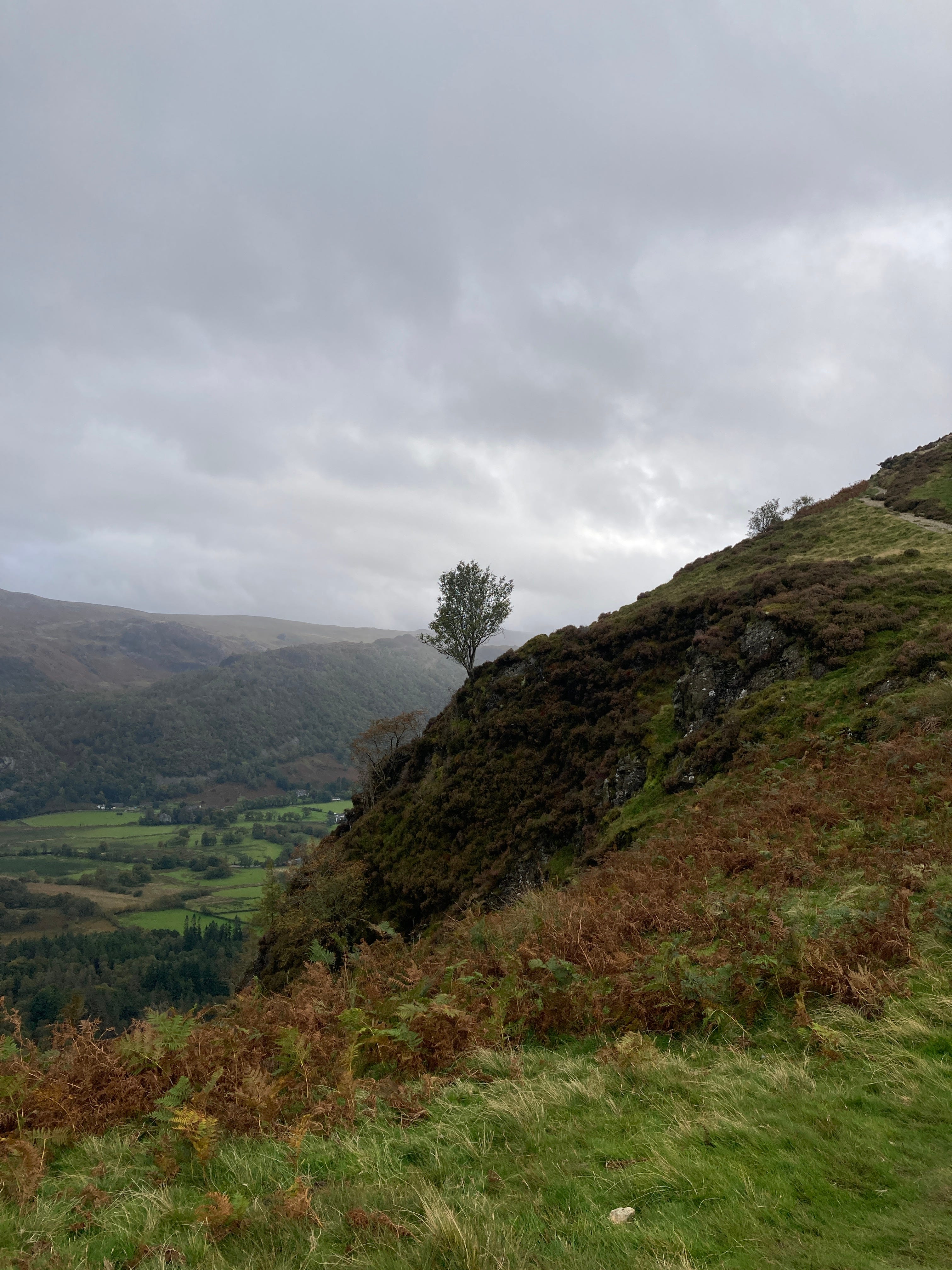
I carried on down the other side of the summit a small way, where the paths flanked by grass were less populated by walkers and I could move at my own pace. To my right, I spied a sheep - maybe even a Herdwick sheep - grazing alone, unbothered. I walked on to the next summit, fairly level with Catbells, just to see what it was like up there. A tree was growing strong, vertical and tall out the side of the fell, thriving as nature so often can in surprising ways. It stood staunchly apart from the swathes of trees in a lower woodland who were moving into their autumn plumage, the oranges, reds, and yellows remarkable against the dark grey of rock, remarkable against the shades of each other. I climbed up the steepest part of the ascent and my feet suddenly felt too light and fluttery in the wind beside the sheer drop, so I knew I wouldn’t go far before sitting down. I sat between scraggy bits of grass to take in the view for a small while, a view that now included the summit of Catbells, as well as the whole of Derwentwater and the fells on the other side of it. While I ate a banana from my bag, I checked the OS map on my phone to learn which fells they were - High Seat, Bleaberry Fell, Dodd Crag. It’s difficult to find meaning in the names, I think, until you’ve scaled the fell itself, until you have a relationship with it.
A spray of rain came in, but nothing wild, just a pleasant misting. I shoved the banana skin into the side pocket of my rucksack and this seemed as good a cue as any to begin my descent in earnest. The steps down this way were steep, unevenly laid stones, and I rather wished the trail had been left in its natural state as I find it much easier to walk on. The artificial craggy pattern scrambles my brain and as soon as the rocks are wet - as they were after the brief spray of rain - I feel more at risk of slipping. I took the route slowly to be careful, but I got frustrated, and the slower steps started hurting my knees. I sped up and worried I would fall. I passed a man sitting on a small promontory, and a woman lying to his side, seemingly napping. We all said hello and she raised her head and watched my feet like a cat watches bicycle tyres, until the rocks gave way to softer, dustier ground and I could move more fluidly.
The trail veered left to wrap around the bottom of the fell and on the road ahead, I could see an ice cream van. I happily stopped to order one and chat to the owner. He was a wiry, weathered man, I guessed in his late 60s, and he told me he’s a mountaineer. He’s done the Bob Graham round at least six times. What a life, I thought, to serve ice cream from a van at the bottom of Catbells and scale mountains all over the world. He had that elsewhere look in his eye, characteristic of those who prefer to be on the move. I wanted to ask him how, why, where, when, but I didn’t know the ends of these questions. I told him that I’d only got into mountains quite recently. He told me how much he loves mountains. Why, which, how? Again, I just didn’t know enough to know what to ask. I took my ice cream, said thank you and goodbye, and strolled happily through the woods.

Suddenly I was back beside the River Derwent, looking back at Catbells and the zigzag path that I had just climbed. As is often the way with a properly good hike, I wondered at who I was when I had stood in that same spot that morning, and who I had become in the meantime. All I had done was move my feet and arms up over a fell and back, but the experience had altered something in my mind. Hours had passed, three and a half, maybe four in all. Over that time my perspective of myself and my priorities had shifted ever so slightly, but I still couldn’t organise my perspective of the landscape. Despite having just done it, I couldn’t square what I was looking at with what I’d seen and touched up close. This is one of the many things I love about mountains. They are bewitching. They seem both impossible and easy, and so far, the truth for me sits somewhere in between.
My legs were aching now and I had to remember they had run an ultramarathon mere days ago. The hardest part of this adventure would be these final steps, back across the field, back through the town. Not all mountains have literal summits. But great news, I thought, as I checked my watch: I’d be back just in time for that pub opening.